Copyright © 2005–2026, All rights reserved to Ruti Aahava.

Ruti introduces an innovative approach to understanding our evolution, who we are, how we evolved and who we will become in the near future.
 

The idea that the language we speak holds immense power, far beyond being merely a means of communication, has been a subject of research and debate among scientists and philosophers for centuries.

Recent discoveries in epigenetics and neuroplasticity provide evidence that our experiences, learning, repeated thoughts and spoken words contribute to the rewiring of neural connections in the brain, influencing physiological, biological, and evolutionary processes.

Findings in neuroscience show that a positive and loving language activates brain regions associated with reward and motivation, supporting psychological and physiological processes related to quality of life, good relationships, social bonding, creativity, good health and longevity.

For the first time, Ruti presents a groundbreaking theory that reveals a profound connection between language and genetics. She emphasizes that, as strange as it may seem, the stories, narratives and words we choose to speak are the driving force that create changes in our DNA, shaping our physical reality and evolution.

In this book, Ruti shows how, at different stages of our divine evolution, divergences from our lineage led to the formation of other species that rewrote their genetic code, thus creating their own separate lineages.

Fossil findings along with new genetic information, often lead to revisions in taxonomic models. These ongoing revisions highlight the need for a more accurate representation of our complex evolution.

Based on her research, Ruti proposes replacing Darwin’s traditional phylogenetic tree of life with a multistaged linear progression focused solely on our evolution, from which the vast diversity of animal species on this planet diverged and evolved into other lineages.

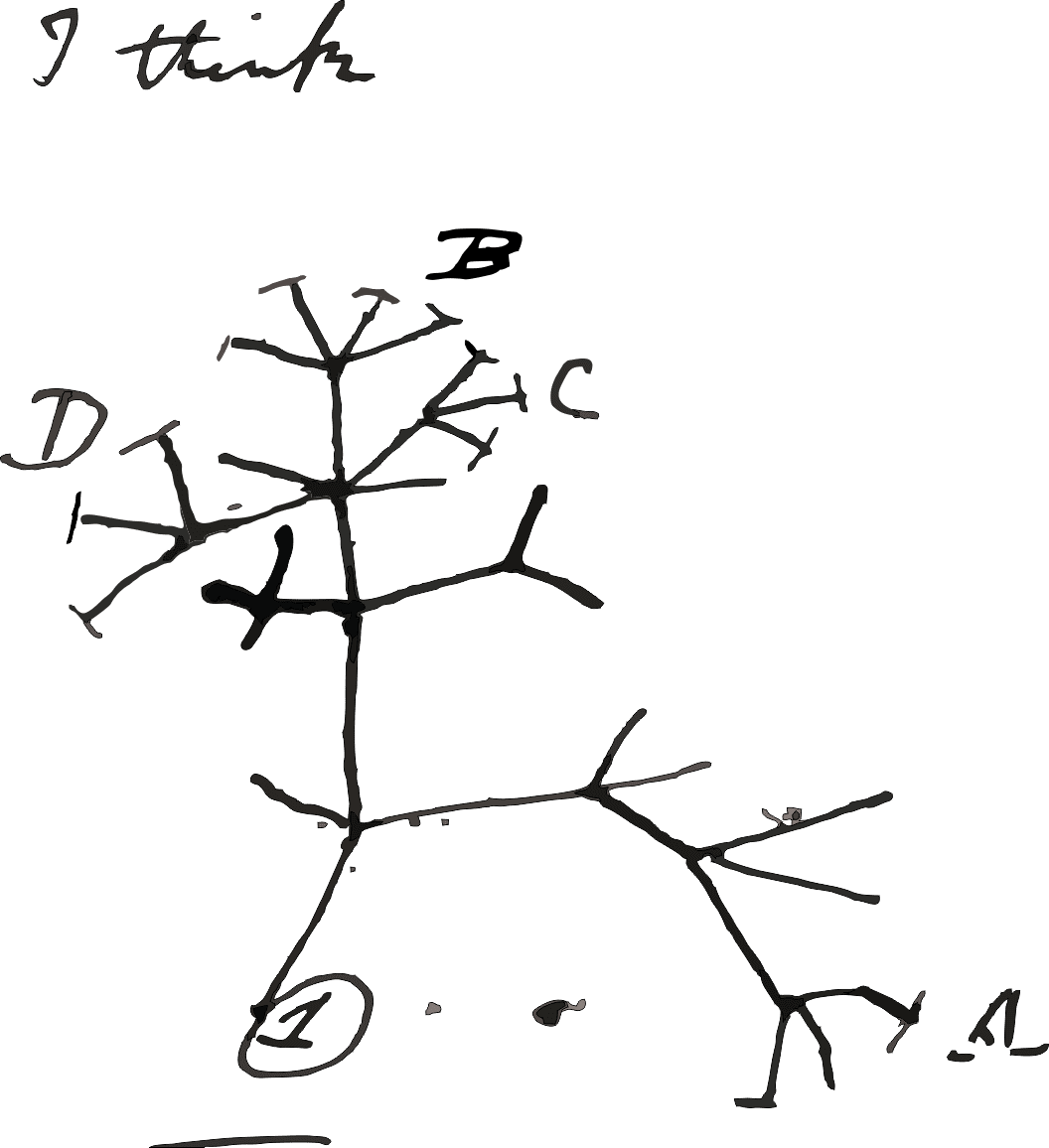
Charles Darwin's 1837 sketch of his first evolutionary tree.

The first evolutionary tree sketched by Charles Darwin in 1837.

A multi staged linear progression of our divine ontelijontic evolution, symbolically numbered 1, 2, 3, and so on…from which all other species living on this planet diverged.

We live in a vibrating universe. The whole of nature is constantly vibrating. Even inanimate objects that appear motionless are vibrating, oscillating and resonating at extremely subtle levels of frequencies. Everything that vibrates creates sound that affects physical reality, even if it is outside of our hearing range of 20 to 20,000 Hz.

The sound frequencies produced by the words we speak, along with their meanings, not only activate the neurons in our brain, but also affect every single cell in our bodysoul (body and soul unified as one).

Everything that exists in our local surroundings and since globalization, also in other distant places is affected by what we say.

The divine language is pure love. This means that words that are not good, loving, or benevolent, cannot further our evolutionary advancement.

The power of language is especially evident in symbolic communication. When we speak loving, advancing, divine words, they bring about genetic changes that further our evolution as divine ontelijontic beings. Conversely, when we speak words that are not divine, our evolution as divine beings ends.

When we speak or tell stories, their meanings materialize in physical reality. They not only generate genetic changes, but also affect our environment, microbiota communities, plants, and the ecosystem of our planet.

Throughout our evolution, as different ontelijontic populations experienced geographical and cultural isolations, the gene pool became limited leading to distinct languages and the development of unique genetic variants.

When a new language evolves it always creates new species of animals, plants,  as well as microorganisms.

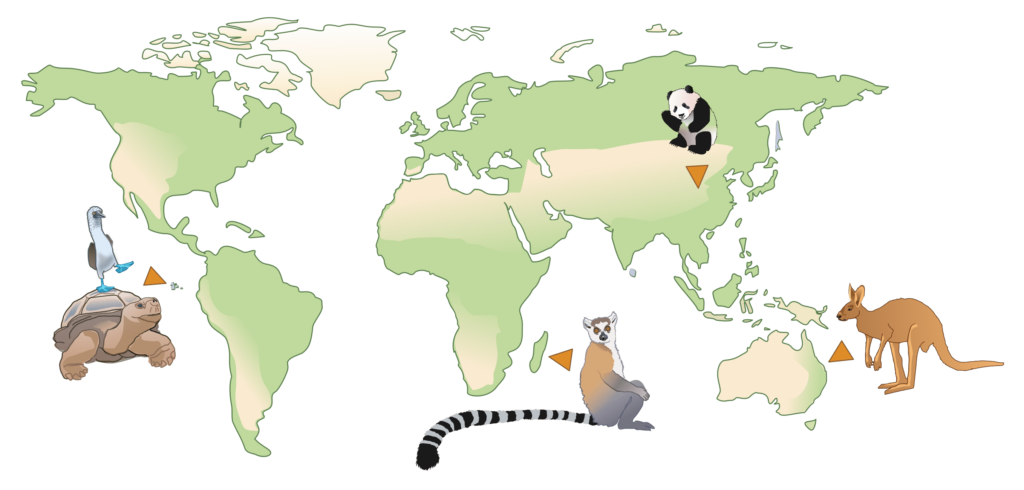
A good example of this phenomenon can be seen in Australia, the Galápagos Islands, Madagascar and other remote locations, where life and plants are unique and unusual. This is because they were completely isolated, adapting to distinct environmental conditions and developing their own unique languages.

Two types of languages shaped our evolution.

1. The divine all loving, perfect, harmonious and ideal language created the life of divine ontelijonts (intelligent beings) throughout the universe.

2. The different languages produced or spoken by us, the divine ontelijonts, and the various languages of the animal species that diverged from us during our evolution.

At every stage of our divine ontelijontic evolution, the languages we produced or spoke created changes to the perfect genetic code that Aahava (love), the one and only divine creator, first said and brought into being. These changes then reshaped our physical bodysouls.

The name ‘Aahava the divine’ refers to the most exalted source of infinite divine love frequency, manifesting as a perfect, ideal, utopian physical reality.

Depending on their language, some divine ontelijonts continued to evolve and advance to their next divine evolutionary stage, while others created genetic changes that caused a divergence from the divine ontelijontic lineage, resulting in entirely new species.

Our ontelijontic evolution was a linear process from simple to complex, meaning that every organ and system in our bodysouls evolved once.

This linear evolutionary process is the way all animals evolve after diverging from us, each following their own separate evolutionary lineage. However, they can only advance within their genetic limitations, devolve (evolve backwards) and lose some of their traits, or stop living on this planet.

As soon as new species came into being, they continue to develop their own independent languages, creating further changes to their genetic sequence. Some form subspecies, while others evolve into entirely new animals, some extremely exotic and bizarre.


This illustration shows four stages of our evolution, from the first eukaryotic cell to the spherical multicellular stage, from about 2,100 – 900 mega (million) years ago.

When a divergence from the divine ontelijontic lineage occurs, the new species remain homogeneous (of the same kind, sharing similar traits) with the stage from which they diverged.

It is as if their DNA stops evolving at the time of divergence, enabling them only to shuffle their genes, duplicate or delete some, switch certain ones on or off, or create new alleles. (Alleles are the slight variations that occur in the DNA bases A, C, G, and T within the same gene. For example, variations in the MC1R gene contribute to a range of hair and skin colours, from dark to light, including red hair.)

About 98-99% of all species that ever lived on this planet are no longer living here, due to several key factors. 

1. The species that branched from our divine ontelijontic lineage continually undergo physical changes due to the constant evolution of their languages. These linguistic changes influence their biological structures, sometimes leading to the emergence of entirely distinct animal species. For example, a group of two legged dinosaurs known as theropods evolved into the modern birds.

2. When languages create too many genetic flaws, life can no longer exist on this planet.

3. Additionally, languages can create transformations in the environment and ecosystem, fundamentally altering our planet’s climate, atmosphere and resources. When these changes become too extreme, many species are unable to adapt and ultimately their lineages stop evolving.

The variety of life on this planet is vast. The relationships and interactions between the different animal species are extremely complex. Working out and piecing together the evolutionary lineages within lineages, each evolving at different rates over different time periods, is an enormously challenging task.

We live in a vibrating universe. The whole of nature is constantly vibrating. Even inanimate objects that appear motionless are vibrating, oscillating and resonating at extremely subtle levels of frequencies. Everything that vibrates creates sound that affects physical reality, even if it is outside our hearing range of 20 to 20,000 Hz.
The sound frequencies produced by the words we speak, along with their meanings, not only activate the neurons in our brain, but also affect every single cell in our body, our neshama and nefesh. Everything that exists in our local surroundings and since globalization, also in other distant places is affected by what we say. (Neshama is the aliveness of all bodily systems, while the nefesh is the entirety of our experiences, thoughts, feelings and consciousness.)
The divine Aahava language is a loving and benevolent language. This means that non divine words cannot advance our evolution further.
Every spoken word in our symbolic language holds tremendous power. When we speak a loving divine language, it advances our evolution as a divine ontelijontic beings. Conversely, when we speak non divine words, our evolution as divine beings ends.

The genus Pan (scientific name) consists of two modern extant species, the chimpanzees with four or possibly five subspecies and the closely related bonobos.

The most frequently asked question about evolution is, if we evolved from the apes, why do apes still live here?
This is a good question and the answer is simple.
We did NOT evolve from the apes, the apes evolved from us.
The genus Pan (scientific name) consists of two modern extant species, the chimpanzees with four or possibly five subspecies and the closely related bonobos.

The bonobos are a more gracile specie that diverged from an ancestral chimpanzee about 930,000 years ago. In English, the word ‘species’ is spelled the same way for both singular and plural forms. However, in this publication, the word ‘specie’ is used specifically to refer to the singular form of ‘species’).

The reason why the modern chimpanzees have subspecies is because they live in different geographical locations and each population has evolved a slightly different language.

The bonobos on the other hand have no subspecies, because their population is concentrated in one geographical area and their language is mostly uniform.

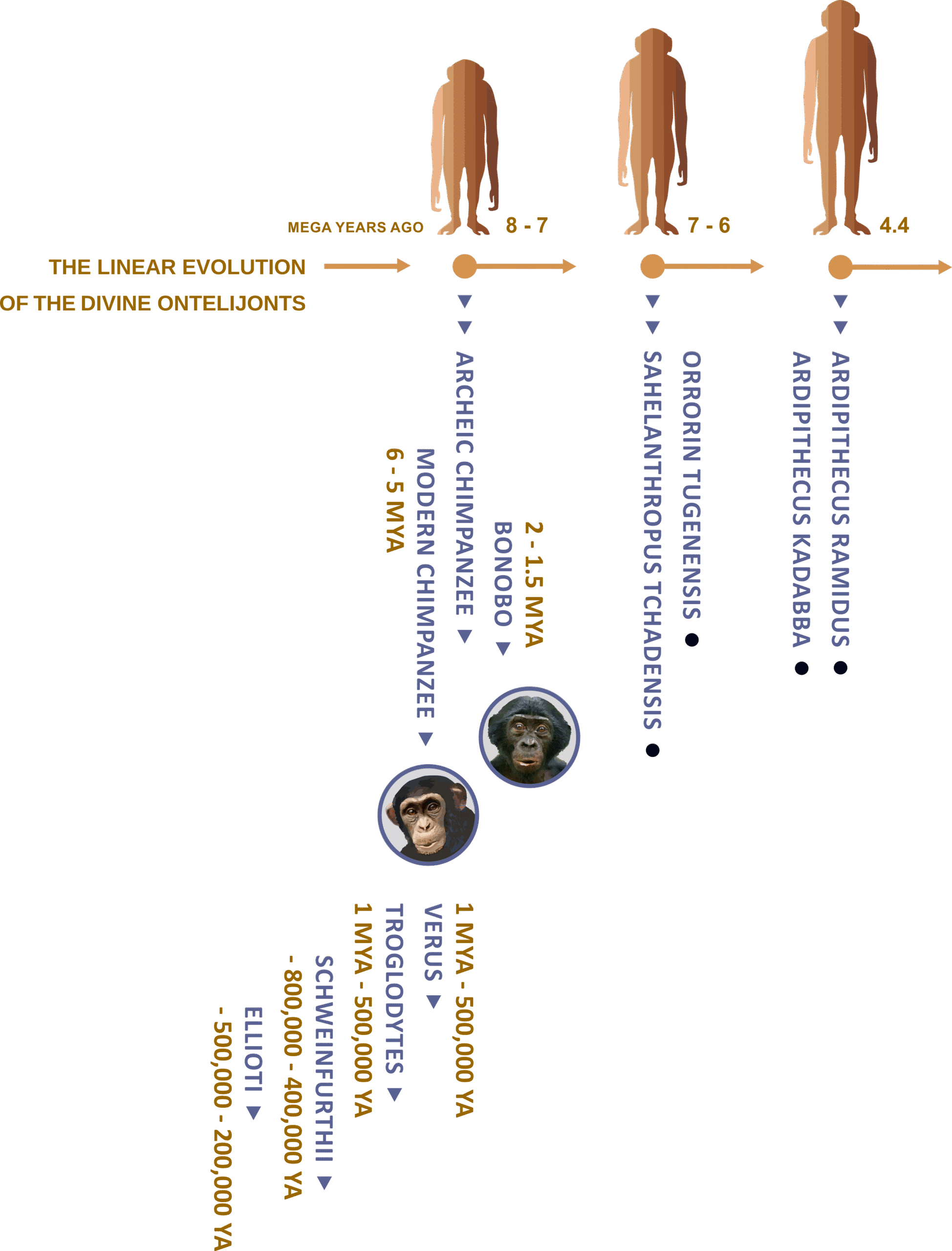
About 8 – 7 mega years ago (mya) or possibly earlier, a group of ontelijonts developed a language that changed their DNA and they diverged from the rest of the ontelijontic evolutionary lineage.

At that time, their physical features were similar to ours. Over time, our genetic structure continued to evolve, leading to us, the divine ontelijonts. Meanwhile, their genetic structure remained similar to when they diverged from us, giving rise to the current great apes, who also evolved since, creating their own distinct evolutionary lineage.

Having diverged from us when the range of our vocalisation was limited and the language areas of our brain were not fully formed, their evolutionary advancement will be limited to the genetics they had at the time of divergence.

The evolutionary lineages of chimpanzees and bonobos will either continue to evolve or cease to exist on this planet, depending on the development of their language.

It is difficult to determine the precise rate of our evolutionary stages, as they are influenced by various factors such as genetics, environmental conditions, language and collective behavior.

According to the fossil record and the geological timeline, our evolution is divided into distinct stages, each stage being more complex, developed and advanced than the previous one.

Darwin’s insight that all living beings are related to one another is a fact that is supported by biochemistry and molecular biology.

With some minor exceptions, the cells of all the living beings on this planet have a uniform genetic code structure and are composed of the same set of 20 amino acids.

This unity of composition shows that the phylogenetic trees of the most diverse animal species on this planet share a common ancestor.

If we go back in time to the different stages of our evolution, the common ancestors of all the different species that exist will always be us, the ontelijonts.

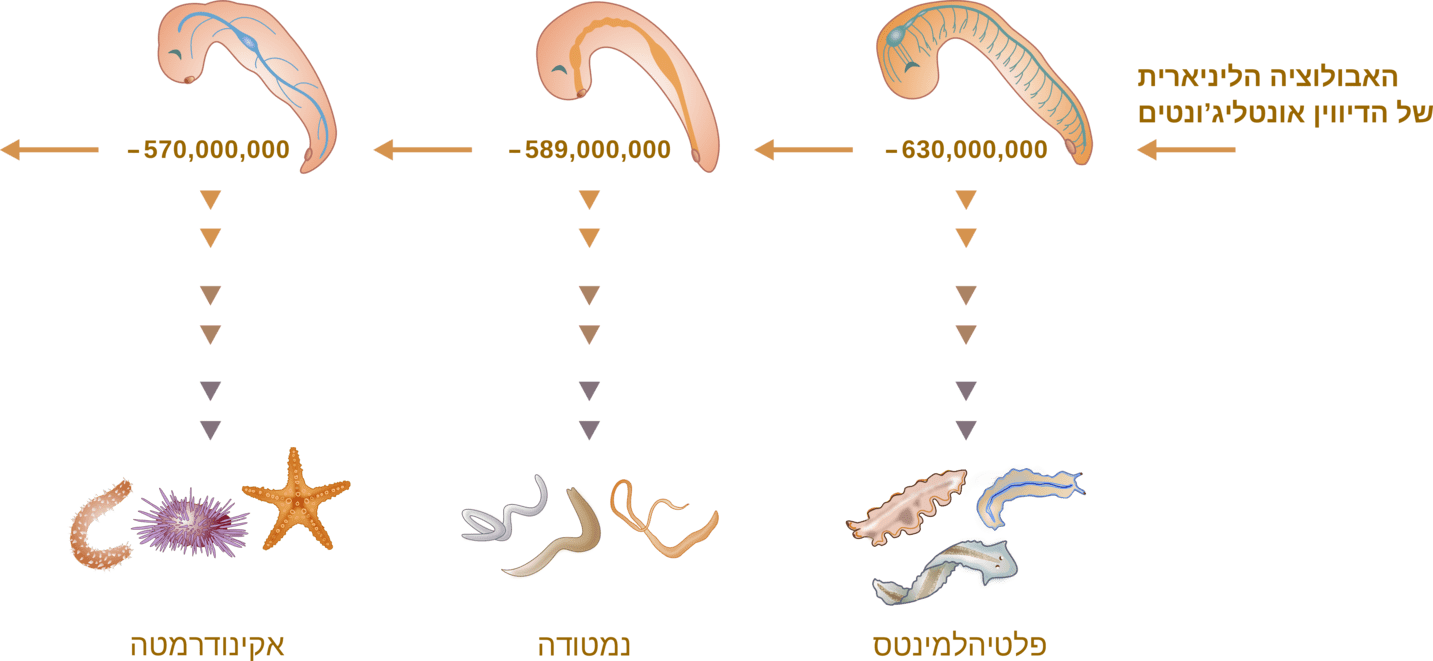
Going back in time to about 630 – 570 mega years ago, is an example of early species that diverged from our evolutionary lineage, when our nervous system, digestion and circulatory systems were only beginning to form.

The Platyhelminthes phylum that separated from us 630 mega years ago contains over 25,000 known living species. 

The Nematoda phylum that separated from us 589 mega years ago contains over 28,000 known living species. 

The Echinodermata phylum that separated from us 570 mega years ago contains over 7,000 known living species.

New fossil discoveries or new data and genetic information that change the understanding of our evolutionary timeline, often create changes to the taxonomy models.

Based on the current model of the phylogenetic evolutionary tree, I propose that the traditional branching tree of life stemming from a single trunk, be replaced by a linear progression representing our ontelijontic evolution, from which at different periods of time or different stages of our evolution, the huge diversity of animal species diverged and evolved from us.

The major linear stages of our ontelijontic evolution are symbolically numbered 1, 2, 3, and so on… From each stage the arrows point to a new phylogenetic tree that was created by the languages we and other animal species produced or spoke. (The phylogenetic trees are symbolic for illustrative purposes only and are not scientifically accurate.)