
The Structure
of the Divine Aahava Language
How to read the divine Aahava language
How to read the divine Aahava language
In the divine Aahava language there are 24 tzilanim (alphabetical letters).
From Alef to Af, each tzlilan is represented by one name, one grapheme
and one unique harmonic phoneme.
The vowel system in the divine Aahava language is based on the five main vowels of the English Language.
(In contemporary Hebrew, there is no difference in the pronunciation of tzere and segol, patah and kamatz, or shuruk and kubutz.)

The consonant sound is pronounced according to the vowel following it.
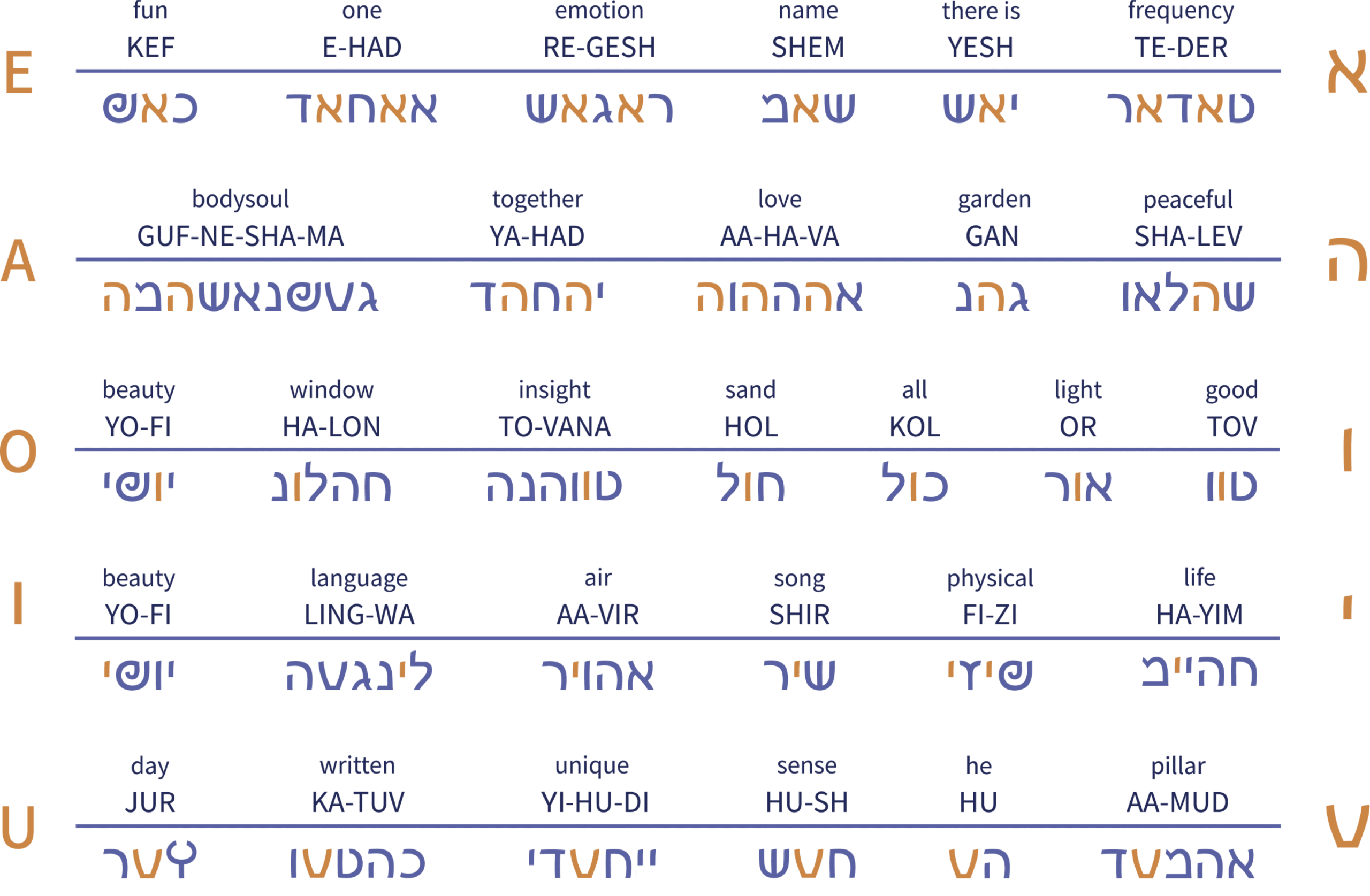
The plural endings can take different forms, all of which are neutral.
Our inner voice
Our inner voice
Everyone channels. Most ontelijonts (intelligent beings) are simply unaware that at times, their inner dialogue is actually a conversation with Aahava the divine, rather than a monologue in which they assume they are merely speaking to themselves.
Our inner voice can be a monologue related to planning daily activities, making decisions, processing emotions and beliefs, recalling past memories, having internal conversations with ourselves etc. It can also be an internal telepathic dialogue with other ontelijonts.
In certain situations, when a non earthly entity appears in the inner dialogue, it may be perceived as a higher divine source or an elevated inner voice arising from a state of positive consciousness. This often occurs during flashes of insight, sudden creative inspiration, or the emergence of knowledge that does not seem to originate from conscious thought processes or familiar collective sources, but instead appears entirely original.
Neurocognitive research has found that areas of the brain associated with language, memory and imagination work together to create a sense of inner conversation, which may sometimes be perceived as a real dialogue, whether the entity is internal or external.
The channellings, or the awakening to the realization that someone was communicating with Ruti Aahava from within her thoughts, began so unexpectedly that it took her a long time to calm down and understand that the entity communicating with her was divine, as all the conversations were loving, pleasant, good, beneficial, inspiring and uplifting.
At first, Aahava the divine, his name and title, spoke within Ruti’s inner voice in a language she did not recognize, a language composed of several different languages that to understand it, she had to refer to dictionaries and other sources of information.
Over the years, extensive knowledge was passed on to her about the divine Aahava language, the course of our evolution and our future as divine ontelijontic beings living an infinite, utopic life in the universe.
From biological evolution to symbolic language
From biological evolution to symbolic language
From the emergence of ontelijontic life on this planet about 3.8 to 3.5 giga (billion) years ago, non linguistic communication such as cell signaling, movement, chemical exchange and later, vocalizations and gestures shaped both the environment and our DNA.
At that early stage, we were not yet conscious or aware that these communication systems may have been slowing the process of our evolution or creating new species.
Compared to the vast span of time since our species began evolving, the capacity for a complex spoken symbolic language may have emerged as early as 200,000 years ago, or earlier, yet clear signs of symbolic behaviour appear in the archaeological record only about 100,000 years ago, primarily in southern Africa.
About 70,000 years ago, a cognitive turning point occurred when our ontelijontic languages became expressive and abstract.
Although very few findings from that early period point directly to divine awareness, archaeologists have uncovered artefacts such as engraved ochre pieces, shell beads and decorated tools used in ceremonial contexts. These findings suggest symbolic behaviour and possibly an awareness of something beyond earthly existence.
In Africa, where we lived for deco mil years * (tens of thousands of years), genetic diversity emerged among the different groups. After we left Africa about 60,000 years ago and spread into different geographical regions, additional genetic differences began to appear among us.
*The number names deso (ten), sento (hundred), and mil (thousand) are inspired by the metric system (SI units): deci (one tenth), centi (one hundredth), and milli (one thousandth).
Scientifically, when the ontelijontic groups become separated over time, genetic changes occur. These are not only the result of adapting to different environments and climates, but also of the development of distinct languages, dialects, cultures and belief systems, all of which continue to create genetic differentiation and changes in our physical reality.
About 40,000 years ago, a significant leap in symbolic communication and artistic expression took place in multiple locations across our planet.
Although there are no direct findings of a spoken symbolic language, the complexity of tools, cave paintings, musical instruments and social cooperation strongly suggests that a spoken symbolic language had fully developed by then.
This development enabled us to tell stories, share ideas, plan ahead and consciously shape our lives. It marked an advance in our intelligence, leading to the formation of more complex linguistic structures such as grammar and syntax, as well as the earliest symbolic graphic signs.
Throughout our evolution, ever since the language areas of the brain began to develop, the divine Aahava language began to emerge in our languages. It was first expressed through gestures and later transitioned into a spoken symbolic language.
This divine language, composed entirely of loving, benevolent, pleasant, harmonious and advancing words, evolved through intuition, channelling, flashes of insight, enlightenment and learning.
During this period, the stories we told, whether fiction or nonfiction and what we said contributed to both significant advances in our lives, as well as difficulties and many challenges.
By about 40,000 – 30,000 years ago, we, the Homo sapiens, were the only remaining ontelijontic species living on this planet. Before this time, our lineage coexisted alongside the Neanderthals, Denisovans and other archaic hominins.
The difference between us and them is that they diverged from us during our evolution, after the languages of certain ontelijontic groups had changed, while other ontelijontic groups, from which we evolved, continued to advance the divine language.
Archaeological discoveries from this period, including the ritual use of ochre pigments and hybrid figurines, point to the rise of spiritual and symbolic thought.
Our biological evolution was irregular and often progressed slowly over cento mega years (hundreds of millionsof years). It was mostly slow, with occasional sudden leaps of advancement. In contrast, our cognitive cultural evolution advanced at a much faster pace following the emergence of the symbolic language, learning capacity and transmission of knowledge. The pace at which knowledge, technology, and creative expression advanced depended largely on our lexicon of words, and what we chose to say.
About 12,000 years ago, during the first agricultural turning point, after gradually transitioning from a nomadic lifestyle to settled farming communities that domesticated plants and animals, we developed the mental capacity and imagination to plan ahead, collaborate, co create, trade and improve the quality of our lives.
In the millennia that followed, several proto languages evolved, some of which have been identified or reconstructed by linguists. Gradually, these early languages developed into language families such as Afroasiatic, Indo European, Sino Tibetan, Dravidian, and Niger Congo, all of which still exist today and include many living languages.
The divine Aahava language may have first emerged from a single proto language and later spread across various other languages. Alternatively, it may have begun evolving within several languages, each containing many or few divine words, along with divine features such as phonetic pitch, sound intensity and tone, as well as morphemes, syllables, syntax and structure.
From ancient languages to divine communication
From ancient languages to divine communication
One of the earliest recorded languages, Sumerian, first appears in written form about 5,200 years ago. It is classified as a language isolate, meaning that it has no clearly established relationship to any known language family. Despite its uncertain origins, the Sumerian civilisation contributed immensely to the advancement of our divine ontelijontic knowledge. Its writing system and its cultural and intellectual achievements in agriculture, astronomy, mathematics and other complex areas of thought were later adapted by neighbouring civilizations.
About 4,600 years ago, the Sumerians of southern Mesopotamia completed the development of the cuneiform writing system. This wedge shaped script that gradually evolved from earlier pictographic symbols, became capable of representing a full spoken language with grammatical structure, making it one of the earliest known writing systems used to record complex ontelijontic thought.
When writing was invented, everything changed. It marked a pivotal time in our history, transitioning from oral traditions to a permanent form of communication. Knowledge became more widespread, as information could now be recorded, preserved and shared beyond the limits of memory and time. However, the knowledge available at that time was still limited compared with our current knowledge and scientific understanding.
About 4,200 years ago Sumerian gradually declined as a spoken language and was replaced in everyday communication by Akkadian. Nevertheless, Sumerian continued to be used for spiritual, literary and scholarly purposes for more than a mil (thousand) years.
Akkadian, one of the earliest documented Semitic languages, flourished throughout ancient Mesopotamia. It developed from the Proto Semitic linguistic tradition that likely existed several thousands of years earlier. Akkadian contained Semitic linguistic features, including a system of triliteral roots, distinctive sound patterns and a complex system of grammatical inflections.
Between about 3,400 to 3,000 years ago several Northwest Semitic languages developed, including Ugaritic, Phoenician and early Canaanite. From this Canaanite linguistic environment Hebrew gradually emerged about 3,200 years ago as a distinct dialect, developing its own linguistic features and cultural identity.
During this period new writing systems appeared, marking a shift from oral traditions to a culture that began documenting its words in written form. The Proto Canaanite script that appeared in the Levant is considered one of the most significant transitional stages in the history of writing. It moved away from earlier pictographic and logographic systems toward a simplified consonantal script that represented individual speech sounds.
From this early alphabet the Phoenician script evolved, consisting of 22 symbols. Its simplicity and efficiency enabled it to spread rapidly across the Mediterranean, directly influencing the early Hebrew alphabet and later the Aramaic, Greek and Latin scripts.
Later at about 2,500 years ago, as Aramaic grew more dominant and became the lingua franca across Mesopotamia and the Near East, it gradually replaced Akkadian, including its Babylonian and Assyrian dialects.
Many communities adopted Aramaic due to its relatively simple grammatical system and its alphabetic script. The Aramaic alphabet developed from the Phoenician alphabet that represented consonantal sounds, which made writing more practical and accessible than the complex cuneiform system composed of hundreds to thousands of signs with multiple phonetic and semantic values.
At about the same time, Aramaic gradually began to replace spoken Hebrew, but not written Hebrew, which remained in use in cultural, literary and official contexts.
Hebrew and Aramaic are closely related Northwest Semitic languages, sharing structural similarities in grammar, vocabulary and root systems. This close linguistic relationship enabled Hebrew speakers to understand Aramaic relatively easily and vice versa. This linguistic closeness had a strong influence on the later stages of Hebrew development, especially in borrowed words, syntactic structures and writing style.
Sometime later, about 1,500 years ago, English, the lingua franca of our time, began to develop from the Germanic branch of the Indo European language family. In contrast, French, Spanish and Italian evolved from Latin, which belongs to the Italic branch of the same family.
Even though languages may belong to different branches or even entirely separate families, they frequently influence one another through trade, cultural exchange and technological development. These connections give rise to a common linguistic phenomenon in which similar sounding words with similar meanings emerge, even when no direct historical relationship exists between them.
In contemporary times, the presence of words such as data, internet, DNA, algorithm, digital, smartphone and more across many languages, often transmitted through English and earlier through Greek and Latin, reflects our evolution towards globalisation and ontelijontic advancement.
What is happening today between English and Hebrew is a fascinating process from a linguistic perspective. With the acceleration of technological developments and the spread of global culture, many English words gradually entered the everyday contemporary Hebrew vocabulary. In many cases these words were added into the grammatical system and often integrated into Hebrew verb forms.
The classical Semitic languages are traditionally organised around triliteral consonantal roots. However, in contemporary Hebrew in order to accommodate the many borrowed words and terms, particularly from English, the root system has been extended to four and even five consonants so that these can be integrated into Hebrew grammar.
Reconstructing the divine Aahava language
Reconstructing the divine Aahava language
The Divine Aahava (Love) language is a neutral, good, loving, benevolent, and advancing language, because the divine creator, Aahava the divine, (his name and title), is neutral, good, loving, benevolent and advancing.
This loving divine language is based on the masculine linguistic structure of the Hebrew language that becomes neutral, incorporating within it masculine and feminine words that also become neutral.
It is possible that during the evolution of our symbolic spoken language, the divine Aahava love language began to emerge in a single location within one language.
However, it is more likely that as populations of ontelijonts spread across different regions and developed different languages, the refined style and structure of the divine Aahava language, together with its phonetic sounds, syllables, words and manner of pronunciation, gradually became dispersed among these languages.
While all languages spoken on this planet contain good, loving, beneficial and advancing words, they also include words and concepts that are not good, creating imperfections to our physical reality and DNA.
To understand the structure and lexicon of the divine Aahava language, it is necessary to identify and compile the information that was intuitively received or channelled over generations from Aahava the divine, and conversely to observe contemporary physical reality, which may help clarify what is divine.
Even though the exact number of existing languages is difficult to determine, mainly due to the classification of different dialects, the emergence of new languages and the decline of others. It is estimated that there are currently about 7,000 spoken languages across the planet, each may potentially contain divine words, concepts or linguistic structures.
In the contemporary diverse linguistic landscape, some languages are spoken by relatively small communities, including many indigenous languages. Meanwhile, Mandarin Chinese is spoken by over a giga (billion) speakers, Spanish, English, Hindi and Arabic are each spoken by centos megas (hundreds of millions) speakers.
Throughout history, certain languages have been regarded as divine, not because of their demographic scale, but because they were believed to be either divine, to function as channels for communication with the divine, or to contain revelations of spiritual knowledge.
From a scientific linguistic perspective, all languages change over time. They undergo phonetic shifts, structural changes and semantic expansion. They develop through social interaction and continuously adapt to cultural and environmental conditions. In addition, languages are influenced by the accumulation of knowledge, scientific progress and technological developments, which generate new concepts, new terms and new patterns of communication.
Given this continuous process of transformation, no contemporary language can be assumed to preserve an original linguistic state in its entirety. Therefore, the divine Aahava language is unlikely to be identical to any single contemporary speech system. Rather than residing fully within one language, it is more plausibly reflected in dispersed fragments, structural patterns and recurring semantic cores distributed across multiple linguistic traditions.
All texts, ancient and contemporary, whether based on historical facts and events, intuitive or imaginary, and whether they are simple to understand or carry deep philosophical layers, create our physical reality.
Copyright © 2004–2026, All rights reserved to Ruti Aahava